

DANTE SOCIETY PRESENTS
ISSUING CITATIONS:
A space for graduate students and early career faculty alike to co-present, interact, and form connections across disciplinary lines.
Issuing Citations (IC) is a public-facing event series aimed at fostering research connections, nurturing inchoate projects, and providing an organizational catalyst for future conferences and publications.
For more information, or to learn about presentation opportunities, please contact us at admin@beatriceinstitute.org.


Past Presentations
Juliana Knot

Juliana is pursuing her masters in Logic, Computation and Methodology. She studies in the Philosophy Department of the Dietrich College of Humanities and Social Sciences at Carnegie Mellon University. Her research interests include causality, the history and philosophy of mathematics, and logic.
Correlation is Causation: Some Formal Properties of INUS Causation
Regularity theories, most famously articulated by David Hume, deny the adage: “causation is not correlation.” In “Cement of the Universe,” J.L. Mackie built on Hume’s description to ground causality as an “insufficient but non-redundant part of an unnecessary but sufficient condition.” I argue that coincidences contain more capacity for structure than previously shown and make plain how coincidences can yield to more thoroughgoing causal inference, analogous to graphical models. This account includes transitive causal chains, hypothetical reasoning, predicting outcomes of interventions, differentiating between chains and common causes, and discovering unobserved common causes.
Lucas Carroll
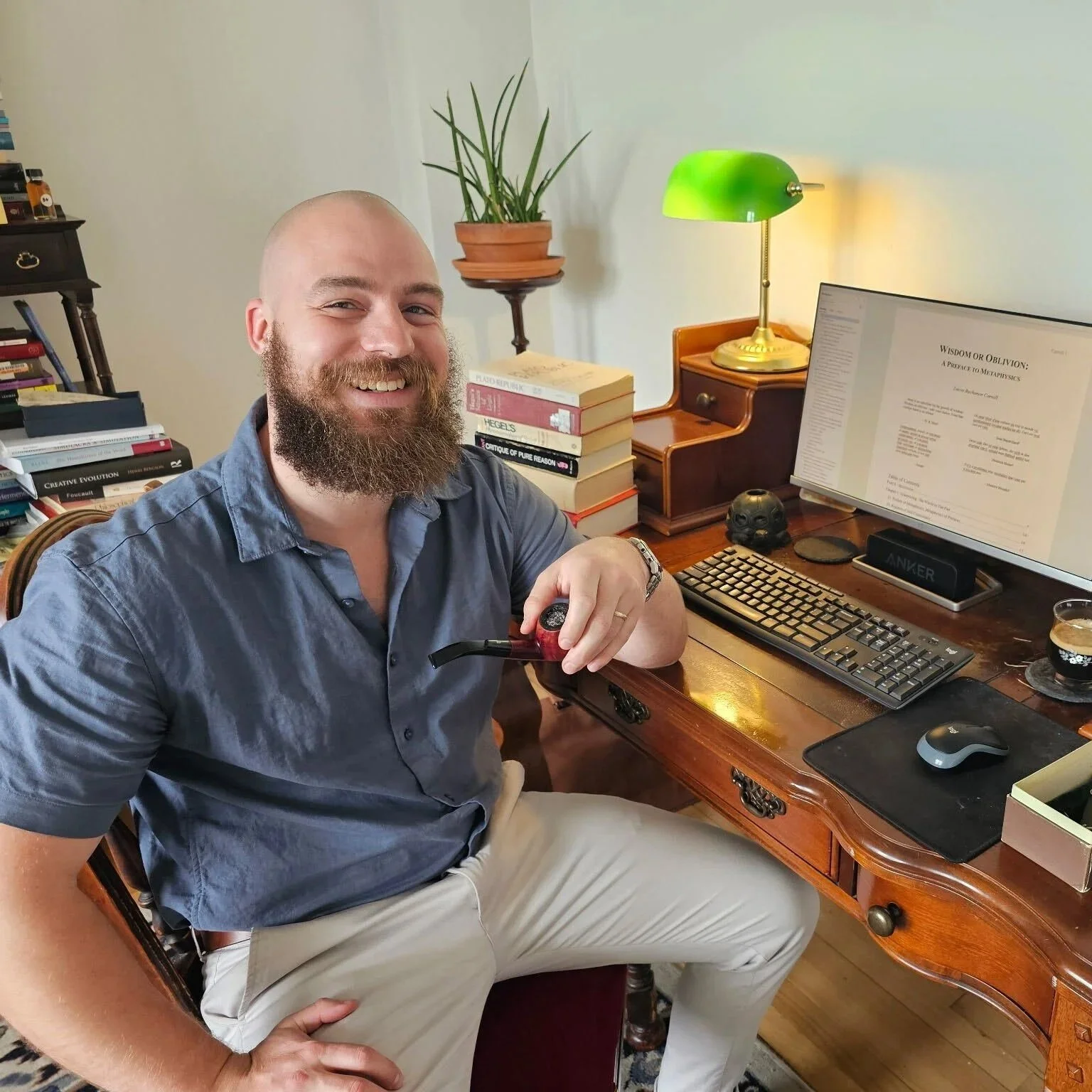
Lucas Carroll is a PhD candidate in Philosophy at Boston College. His research centers on the history and critique of metaphysics, on the phenomena of theoretical speech and the practice of dialogue, and on ethics and anthropology in the context of modern technology.
The Fragile Word: Metaphysics and the Conservation of Theoreticity
Lucas stages a connection between metaphysical discourse and the theoretical word. He argues that metaphysics is the reflexive self-affirmation of theoreticity as such—and that, this being the case, there exists a specific and urgent vocation of metaphysics vis-à-vis the human possibility for uttering a word of truth, for theoreticity. He sheds light on the concept of "theory" by resituating it within its originating metaphorical context. Then, he speaks about theoreticity-in-itself, and defines metaphysical discourse as theoreticity-for-itself. He deploys the primary theorem of metaphysics: "theoreticity is," and turns in his claims to the paradoxes involved in determining this affirmation. He resolves these paradoxes by exhibiting the real fragility of theoreticity. Lastly, he shows how, in light of the contingent subtraction of theoreticity, metaphysical discourse can be understood as the formal conservator of the theoretical word.
Sarah Moore
Sarah received her M.A. in Linguistics from the University of Georgia.
"I Don't Expect to Be Forgiven": How YouTubers Navigate Identity Formation Through Enregistering the "YouTube Apology"
Apologies can take many forms, and "I'm sorry" can convey many meanings depending on the delivery of the message. In an attempt to better understand apologies made in digital spaces, this study focuses on investigating how YouTubers negotiate their online identity and resolve conflict while making apologies through semiotic strategies including language, dress, environment, and video recording techniques. It also seeks to find if the patterning of these strategies has become a mainstream, cross-linguistic template in an age of digitally mediated globalization.
Twenty videos from both English-speaking and Brazilian Portuguese-speaking YouTubers have been analyzed for the use of six apology strategies adapted from Blum-Kula et al's (1989) CCSARP Coding Manual for Apologies. Results of this study suggest that the "YouTube apology video" is enregistered via pragmatic apology strategies and semiotic devices across languages.
Raimundo Cox

Raimundo received his BA and MA in Philosophy at Universidad de los Andes in his home country of Chile. He now pursues a PhD in Philosophy at the University of Pittsburgh where his research focuses on Kant's metaphysics and its connection with his practical philosophy, as well as the methodological and historical aspects of Kant, Suárez, and Hegel’s thought.
Kant and the Question of Metaphysics
Since Aristotle, philosophers have aimed to develop a science that explains the fundamental principles and causes of reality. For centuries, this discipline—metaphysics—was seen as essential for grounding our understanding of the world, our moral principles, and even our religious beliefs. But in the Modern era, metaphysics came under increasing suspicion, and today metaphysical claims often strike us as obscure or untrustworthy.
In this talk, I explore how the philosopher Immanuel Kant confronted this crisis. Although Kant is often portrayed as an opponent of metaphysics, I will show that his project is not simply to criticize metaphysical speculation. Rather, Kant seeks to rescue and transform metaphysics by giving it a new scientific foundation. My aim is to explain, in accessible terms, how Kant redefines the scope and method of metaphysics and why his approach may still matter for contemporary questions about knowledge, morality, and religion.
Joanna Boyland

Joanna is pursuing a PhD in Logic, Computation, and Methodology at Carnegie Mellon University. Her research focuses on logic and programming languages.
A Translation for Proof-Theoretic Programming Languages
The field of proof theory discusses what makes a valid proof. It sits at the intersection of philosophy and mathematics. The field of type theory discusses how to categorize different constructs in a programming language. It sits at the intersection of computer science and, again, mathematics. It was gradually discovered in the last century that, in some rigorous sense, a proof of a statement is the same as a program of a type; proof theory and type theory are two lenses on the same concepts.
We will discuss a translation from one formal language to another, viewing both the source language and the target language through both these two lenses. I will share a nice proof-theoretic property of this translation, and briefly mention a nice computational property it has.
Alexander Exum

Alex is pursuing a PhD in Theology at Duquesne.
Newman, Aquinas, and the Creative Potential of the Conscience
To live and move as a moral agent requires the ability to discern good from bad and act accordingly. Were the good of the natural order made intelligible through the intentional ordering of those goods, then the moral agent would need a way to discover this intelligibility within themselves. This, for John Henry Newman, is the role of the conscience.
This discussion will trace two developments in Newman’s thought on the conscience: conscience as morally perfective, and conscience as epistemically significant. Understood within Aquinas’s distinction between objective impression (synderesis) and subjective disposition (conscientia), Newman shows conscience to be a real but deficient experience of God, who is intimately involved in the self-creation and self-knowledge of each human person. It is the voice of God which beckons from the center of human being as both limit and potentiality, moving the person toward what they were created to be.